Before the recording studio, the albums and the industry nominations, there was a kid who belonged to two musical worlds at once—and a mother who had the perfect way of describing him.
“You Indian dance to the pencil sharpener and you moonwalk back to your desk.”
That was how Isabel Dockstader, the mother who raised Chief Rock, remembers the young dancer. In one line she caught the two parts of his upbringing: traditional life at Six Nations of the Grand River, and the multicultural streets and classrooms of Hamilton, Ontario.
The boy who moved between those worlds would grow into a Cayuga MC, producer, dancer, filmmaker and mentor. He would tour, make albums, learn to engineer, teach younger artists and eventually build a studio of his own. The funny part is that rapping wasn't even his first love.
A dancer long before an MC
He grew up at powwows, social dances, longhouse gatherings and ceremonies, surrounded by drums, songs and family. In Hamilton, he was surrounded by friends from many backgrounds and a different set of rhythms: hip-hop, R&B, breakbeats, turntables and the sound of people making things from nothing. There was also country, rock and blues around Six Nations. He didn't treat any of those worlds as mutually exclusive.
Chief Rock remembers himself first as a dancer and beatboxer. He learned Fancy, Grass and Hoop dancing, Iroquois social dances, breaking and other hip-hop dance styles. In the city he found people who shared the whole culture—DJs, graffiti artists, B-boys and rappers—not just its records.
He moved through the early Rakunz dance crew and later Stylordz, formed by his friend TRX. A detailed 2018 Hamilton hip-hop retrospective, assembled with recollections from participants in that scene, connects him to the wider Ballyhoo Crew circle. Those names weren't marketing concepts; they were the people and rooms where his creative identity took shape.
Every studio taught him something
He remembers Double Ice and Triggerman of Legal Eye as two of the people who helped him understand the machinery behind a song: how to build a beat, arrange verses and turn an idea into a recording. He kept learning in studios across Hamilton and the Toronto area.
But being in a studio and hearing the song exactly as he imagined it were not always the same thing. He would come in with a sound in his head and leave knowing that something had been lost between the idea and the playback. In his words, he wanted to “capture the lightning in a bottle.”
So he kept learning. Recording became engineering. Engineering led to mixing and mastering. He taught himself to shoot and edit videos, too. The studio he eventually built, Enter-Tribal Studioz, wasn't simply about saving money on sessions. It was about being able to finish a creative idea without handing away the parts that mattered most.
The remix that came from living both lives
BEYOND THE COVER
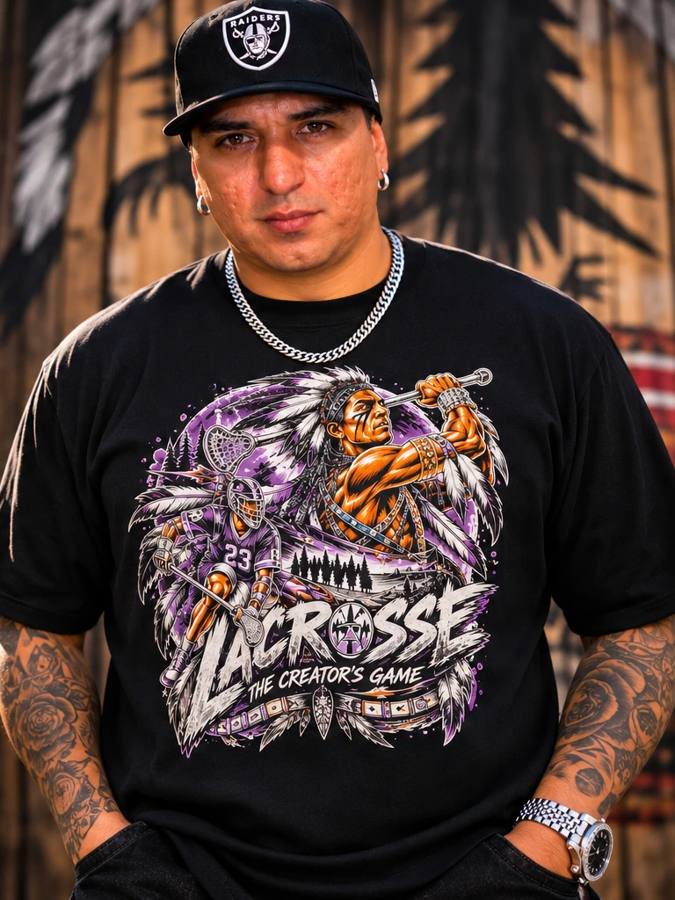
Photography from the artists' own public websites. Select an image to open its original gallery.


As rap became more influential among Indigenous youth, he wanted young listeners to feel the same pride in traditional songs that they felt hearing hip-hop. So he began blending Six Nations social-dance music with beats and rhythms from the city.
He recalls being unaware of others making that particular combination in his own circle at the time. The fusion drew attention and, sometimes, debate. A widely shared powwow dance video featuring his music and dancers in Fancy and Jingle Dress styles, he says, drew more than a million views across postings; that count remains an artist recollection, not an independently audited total.
What's documented is the music itself. In 2012, RPM Records featured his “Smoke Dance Hip Hop Remix”, describing the meeting of Smoke Dance music and bass-driven production. The real point was never to make tradition sound fashionable. It was to help younger people hear their own culture inside a contemporary sound they loved.
The records—and the name that got split
His debut, The Relentless Warrior, is listed on Apple Music with a 2001 release date. His larger catalogue also includes No Holding Me Back, A Warriors Journey, projects released under the Chief Rock name, and Enter-Tribal recordings.
Then there's the small metadata problem with a big impact: some streaming services list “Chief Rock the Relentless Warrior” as the artist for A Warriors Journey. Chief Rock explains that Chief Rock was always the principal artist name. The Relentless Warrior was a secondary identity—a hip-hop moniker—not part of one giant artist name. A listener looking for his full catalogue could end up thinking those were different performers.
In 2025, he released The Unreleased, an archival collection of songs recorded at different points from 2006 to 2010 that had never appeared on his earlier albums. That date matters. The album didn't begin in 2025; it brought a missing period of his recording life back into public view.
The recognition that didn't always travel
His work has been recognized beyond his own community. At the 2015 Indigenous Music Awards, Enter-Tribal's Hitting the Trail won Best Album Cover Design, and Chief Rock's A Warriors Journey was nominated for Best Rap/Hip-Hop CD. The contemporary awards report records both achievements.
His official biography also documents work associated with Tom Cochrane and Susan Aglukark, television appearances including Buffalo Tracks and APTN LIVE, and an extended performance tour in Guyana. He has met musicians and actors across the Indigenous arts scene who know his name. But that recognition has not always translated into a large audience for the records.
There is no need to invent a conspiracy about why. Independent artists frequently have to do the jobs of an entire team. Chief Rock's unusual problem is that he really has done many of them.
The reason he kept the door open
He estimates he has recorded or produced work with more than ten artists in the Hamilton–Toronto area, plus collaborators elsewhere. His video catalogue includes “Rez Reppin',” “Colourless Hand,” “Sisterz,” “Sovereignty,” “4 Push Ups” and “Frontlines.” Some of that work places him in front of the camera. Some places him behind it, doing the production that audiences rarely see.
That experience shaped his youth mentorship, too. Through Ancestral Vibes workshops, he offers lessons in beats, songwriting, recording, performance and telling personal stories through music. The same tools he once had to learn by trial and error are now things he can put in someone else's hands.
Enter-Tribal has changed lineups over time. He remembers an early collaborator whom he prefers not to name, followed by Beka Solo, before the project evolved into its current partnership with MzShellz. Both remain solo artists; together, they record and perform under the Enter-Tribal name. Their collaboration also became a lasting romantic and creative partnership.
Still moving between worlds
The kid who danced to the pencil sharpener and moonwalked back to his desk never really stopped doing either one. He still moves between traditional and contemporary forms, between the stage and the studio, and between making records for himself and helping other artists make theirs.
His catalogue now reaches from the early 2000s to newly released archival sessions and contemporary collaborations. His next announced project, Strength, Pride, Reclamation, points toward another chapter.
The most interesting question isn't why Chief Rock hasn't stopped making music. It's what happens when more people finally hear everything he's already made.
Editorial disclosure: This publisher-affiliated profile was prepared by the Vibe Tribe Editorial Desk from Chief Rock's firsthand account and publicly documented recording, performance, workshop and award sources. Personal stories, mentor accounts and the reported viral-video audience are attributed to the artist, not presented as independently verified statistics. No new interview dialogue has been invented.
Start here: Watch “Rez Reppin'” · Hear the catalogue · Explore the videos · See the 2015 Indigenous Music Awards results